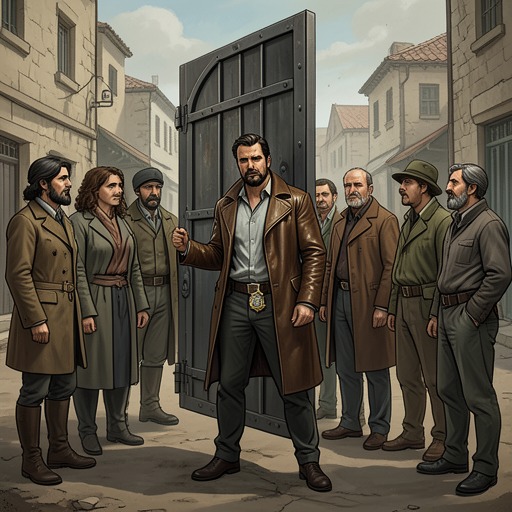
Tom White and Dudley White’s brotherly relationship
Killers of the Flower MoonT. B. White and Dudley White’s brotherly relationship joined the intimacy of a close family bond to the hazards of a shared life in law enforcement. The brothers entered the Texas Rangers together, but served in separate companies; in 1918, Dudley was killed while attempting to arrest two deserters in East Texas. His death brought the dangers T. B. White had witnessed as a lawman into his own family, taking from him the older brother he had regarded as seemingly invulnerable.
Brothers in a Texas household
T. B. White was born in 1881, the third of five children in a poor family living in the hill country outside Austin. His older brother Dudley was described as bruising in build, and the brothers were particularly close. Their childhood was shaped by hard work and a rural isolation in which the nearest one-room schoolhouse stood three miles away. Their father, Robert Emmett White, had migrated from Tennessee to central Texas in 1870; he and the children’s mother, Maggie, lived in a log cabin, herding cattle and growing what food they could.
When T. B. White was six, Maggie died, apparently from complications after childbirth. Robert Emmett White was left to raise five children, all younger than ten. The account does not describe how the brothers responded individually to that loss, but it locates their closeness within a household forced to continue under their father’s sole care. In 1888, Robert Emmett White became sheriff of Travis County. The law-enforcement path his sons later followed was thus also the occupation of the father who had raised them.
A shared calling, separate companies
In 1905, T. B. White enlisted in the Texas Rangers. Dudley, drawn by the same Ranger mystique, joined the force that year. They were assigned to separate companies, so their common service did not mean that they worked side by side in the field. Their younger brother Doc also joined the Rangers, making law enforcement a strikingly shared family vocation, though the evidence identifies T. B. White and Dudley White as particularly close.
The work joined the brothers to an institution whose heroic reputation among white Texans stood alongside its brutal, shoot-first methods toward American Indians and Mexicans. For T. B. White, service meant a meager salary and work in rough camps, learning practical skills from experienced officers. The evidence does not specify Dudley’s assignments or compare their reputations as Rangers. What it does establish is the contrast between their separate postings and their shared exposure to the risks of the same profession: the brothers had chosen a common line of work, but its dangers could reach one of them far from the other.
Dudley’s death in the Big Thicket
In July 1918, Dudley and another Ranger went to arrest two deserters believed to be hiding in the Big Thicket, a remote, wooded area of East Texas. During an obliterating drought, the officers searched a clapboard house, found the suspects absent, and waited on the porch. At three in the morning the deserters ambushed them. Dudley’s partner was shot twice; from the porch, wounded and bleeding, he saw Dudley standing and firing his six-shooter before a bullet struck Dudley near the heart and brought him down.
Dudley was married and had three children under the age of eight. To T. B. White, his brother had seemed invulnerable, and the news of his death left him overcome. That description makes the loss more than the death of a fellow officer: the figure who had shared his childhood and profession had appeared, in his eyes, beyond the reach of the violence that regularly claimed lawmen. The ambush abruptly disproved that sense of safety within the family itself.
The family’s aftermath
The two deserters were caught and prosecuted for murder. Robert Emmett White attended every day of their trial until both men were convicted. His presence connected the family’s loss to a public reckoning, while Dudley’s death remained marked by the material details of a lawman’s killing. His body was transported home, and a Ranger report recorded the wagon sheet, bed sheet, and pillow used to ship it. T. B. White and his family retrieved Dudley’s possessions, including the soft-nosed, steel-jacketed bullet that had killed him.
Dudley was buried in a cemetery near the ranch where he had been born, placing his grave close to the landscape of the brothers’ beginnings. An obelisk identified him as John Dudley White, Sr. The account’s movement from the Ranger report’s spare inventory to the family’s recovery of the fatal bullet gives the relationship a stark physical ending: a professional record of a transported body sits beside the personal act of reclaiming the dead brother’s belongings. Their shared service had made the danger of a lawman’s life familiar to T. B. White; Dudley’s death made that danger irreducibly personal.